Rake and Trail
The two numbers that govern steering feel
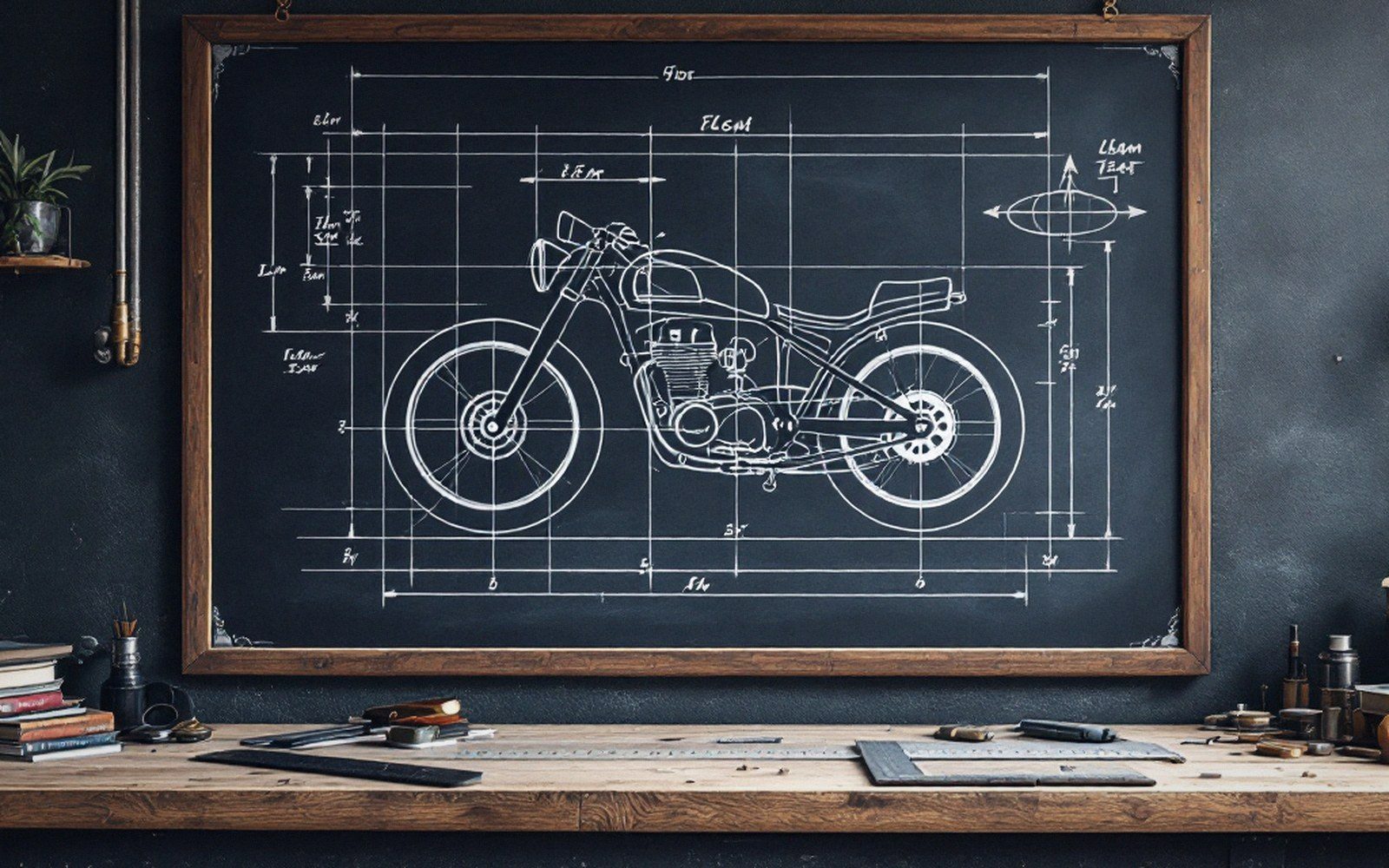
Lean a steering axis away from vertical and the contact patch moves behind the point where that axis meets the ground. Those two facts — the angle of the axis and the distance between axis-ground-point and actual contact patch — are rake and trail. Neither is decorative. Together they determine the magnitude of the restoring moment that pushes the wheel back toward straight after a disturbance, and they set the force a rider must apply to initiate a turn. Get them wrong and the machine either wanders and fights correction, or darts and never settles.
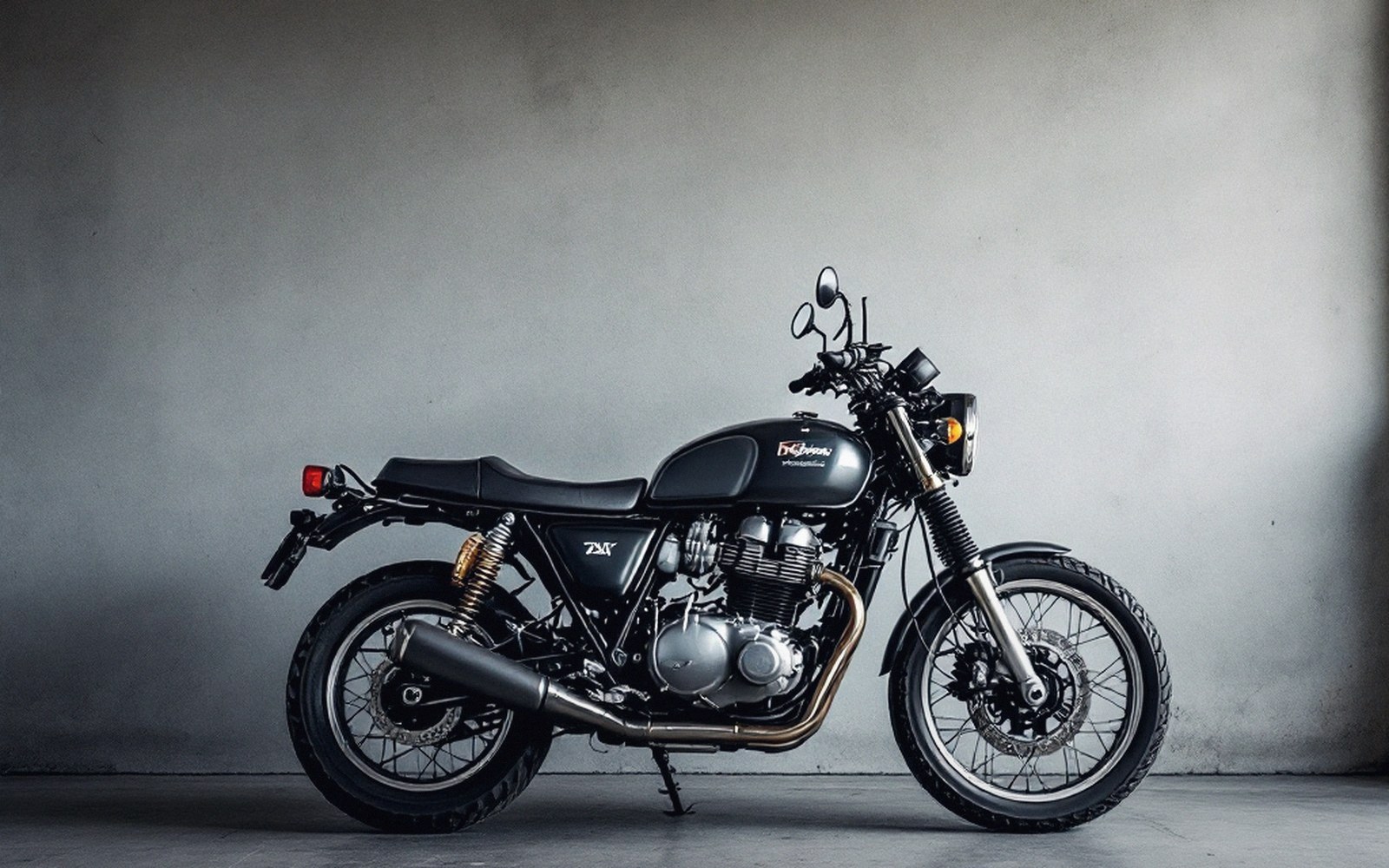
Rake is measured as the angle between the steering axis and the vertical — so a motorcycle with a 25-degree rake has its fork inclined 25 degrees from plumb. American cruiser practice has traditionally run more raked-out numbers, sometimes past 35 degrees, while road-racing machines and committed sportsbikes tend to cluster between 23 and 26 degrees. The angle is set by the geometry of the frame's headstock, and it cannot be changed without rebuilding or rejigging that structure, which is why getting it right at the design stage matters so much.
Trail is the horizontal distance, measured along the ground plane, between where the steering axis projects down to the surface and where the tyre actually contacts it. Because the fork is raked backward, the contact patch sits behind the projected axis — the wheel is, in a literal sense, trailing. This is the quantity that drives steering behavior most directly. More trail means a larger restoring moment: disturb the wheel and the geometry wants to drag it back to center with more force. Less trail means the wheel responds more readily to small inputs and less readily corrects itself.
The two numbers are coupled. Increase rake and, for a given fork length and tyre radius, trail increases automatically. Reduce rake and trail shrinks. A designer who wants a lot of rake for style or weight distribution but moderate trail must increase the fork offset — the perpendicular distance between the steering axis and the front axle — because fork offset subtracts directly from the trail the rake would otherwise generate. This offset is sometimes called the fork crown offset or simply the yoke offset, and it is the fine-tuning instrument in the geometry equation.
What the numbers actually do to the machine
A wheel with generous trail behaves like a shopping trolley caster: disturb it and it snaps back. On a motorcycle this translates to straight-line stability and resistance to turning — the machine wants to continue what it is already doing. Countersteering is the mechanism by which this resistance is overcome at speed; the rider pushes the bar away from the intended corner, the front wheel steers briefly outward, and the resulting fall does the actual turning. The force required for that initial push scales with the restoring moment, which scales with trail.
Reduce trail and the machine becomes more agile but also more nervous. Very low trail — below roughly 80 mm in most road-going configurations — can produce a front end that feels vague or that refuses to settle at speed. Push it too far negative and the wheel becomes self-steering in the wrong direction: a disturbance amplifies rather than damps, which is fundamentally unstable. Practical trail figures for road and track machines occupy a fairly narrow band, generally 80–120 mm, with track-focused machines tending toward the lower end of that range to reduce the bar effort needed in fast direction changes.
Camber thrust — the side force a leaned tyre generates from its own contact geometry — also interacts with trail. As the machine leans into a corner, the camber thrust contribution to cornering force changes, and the steering geometry must accommodate the way the effective contact patch shifts across the tyre's cross-section. A tyre with a rounder profile moves its contact patch less for a given lean angle than a flatter one, which is why tyre profile and chassis geometry are calibrated together rather than independently.
Gyroscopic forces add another layer. The spinning front wheel resists being tilted — that resistance, gyroscopic precession, acts on the steering axis during roll initiation and contributes to the feel of the transition from upright to leaned. Trail and gyroscopic moment are not the same thing, but they arrive at the wheel simultaneously and the rider experiences their sum. Engineers separating the two contributions in testing need instrumented rigs rather than subjective reports, because human perception conflates them reliably.
How designers have moved those numbers
Rex McCandless and his brother Cromie McCandless, working in Belfast in the late 1940s, arrived at a headstock geometry for the Norton Featherbed frame that was notably more considered than most of its contemporaries. The Featherbed frame combined a stiffer structure with steering geometry that allowed the power Norton's engines already produced to be used consistently — the fork angle and trail were matched to the chassis rather than inherited from whatever had come before. That matching of geometry to structural rigidity is now a baseline assumption in frame design, but it was far from universal in that era.
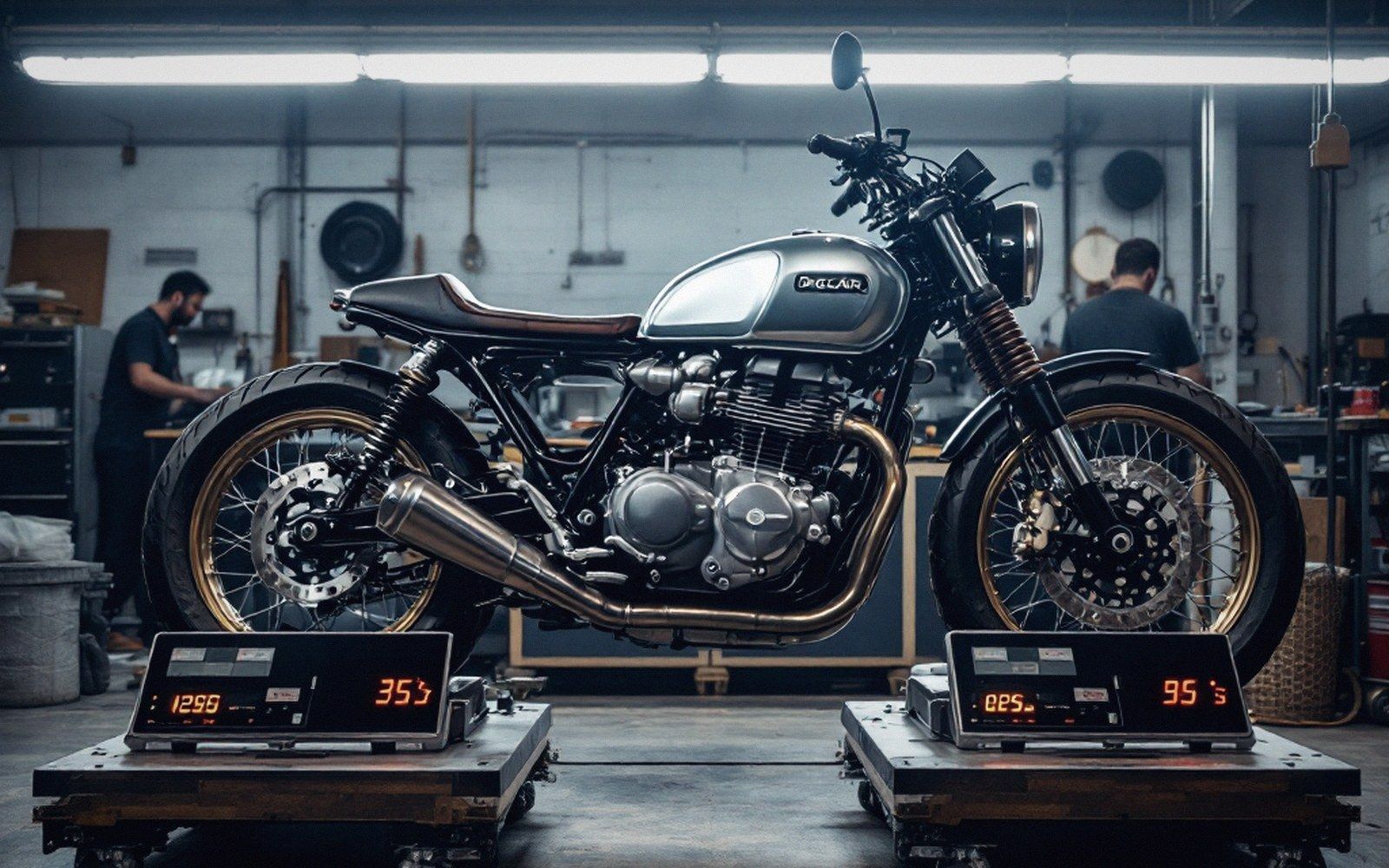
BMW Motorrad, developing the R series through its Munich engineering operation, long maintained conservative rake and trail figures tuned to the inertial peculiarities of the flat-twin layout — cylinders extending laterally alter the roll inertia of the engine assembly, which in turn affects how quickly the machine responds to steering inputs. Bologna-based Ducati took a different path with its L-twin sportsbikes, using steep rake angles and short trail figures to achieve the quick steering response that narrow, high-revving race replicas demand. Honda's approach across its wide model range has generally been to tune trail more conservatively, accepting slightly heavier steering in exchange for better resistance to perturbation on imperfect surfaces.
The Isle of Man TT course exposes geometry choices that are marginal on ordinary roads. The sustained high-speed sections demand trail that provides stability without demanding excessive bar force; the tight, cambered village sections need a machine that can change direction with minimal delay. Machines prepared specifically for the Mountain Course often run geometry that compromises neither extreme aggressively — a narrow band of rake and trail that makes them slightly less specialised than pure short-circuit racers but that survives the full lap rather than excelling at one type of corner.
One thing static figures cannot tell you is what happens when the fork compresses under braking. Trail is a function of geometry and geometry changes with fork travel: as the front compresses and dive occurs, rake decreases and trail shortens. A machine with 100 mm of trail at rest may have significantly less when braking hard into a corner, which is the moment when stability is most critical and trail is doing the most work. This is why some suspension designs — anti-dive linkages, hub-centre systems — have been pursued specifically to keep trail closer to its static value under load. The static number in a specification table describes only one condition of a continuously changing relationship.
Read next
Elsewhere on the site Steering
Countersteering
Above walking pace you turn by pushing the bar away from the corner and the machine falls into the turn.
 The Front End
The telescopic fork
Almost universal and structurally poor: it bends under braking and its damping fights its own suspension duty.
 Engine as Layout
The flat twin
Cylinders in the airflow and mass carried low, at the cost of width and a torque reaction when you blip it.