Gyroscopic Precession
A spinning wheel resists being tilted and responds ninety degrees later — which is why pressing forward on a bar makes the machine fall sideways.
What the gyroscope actually does
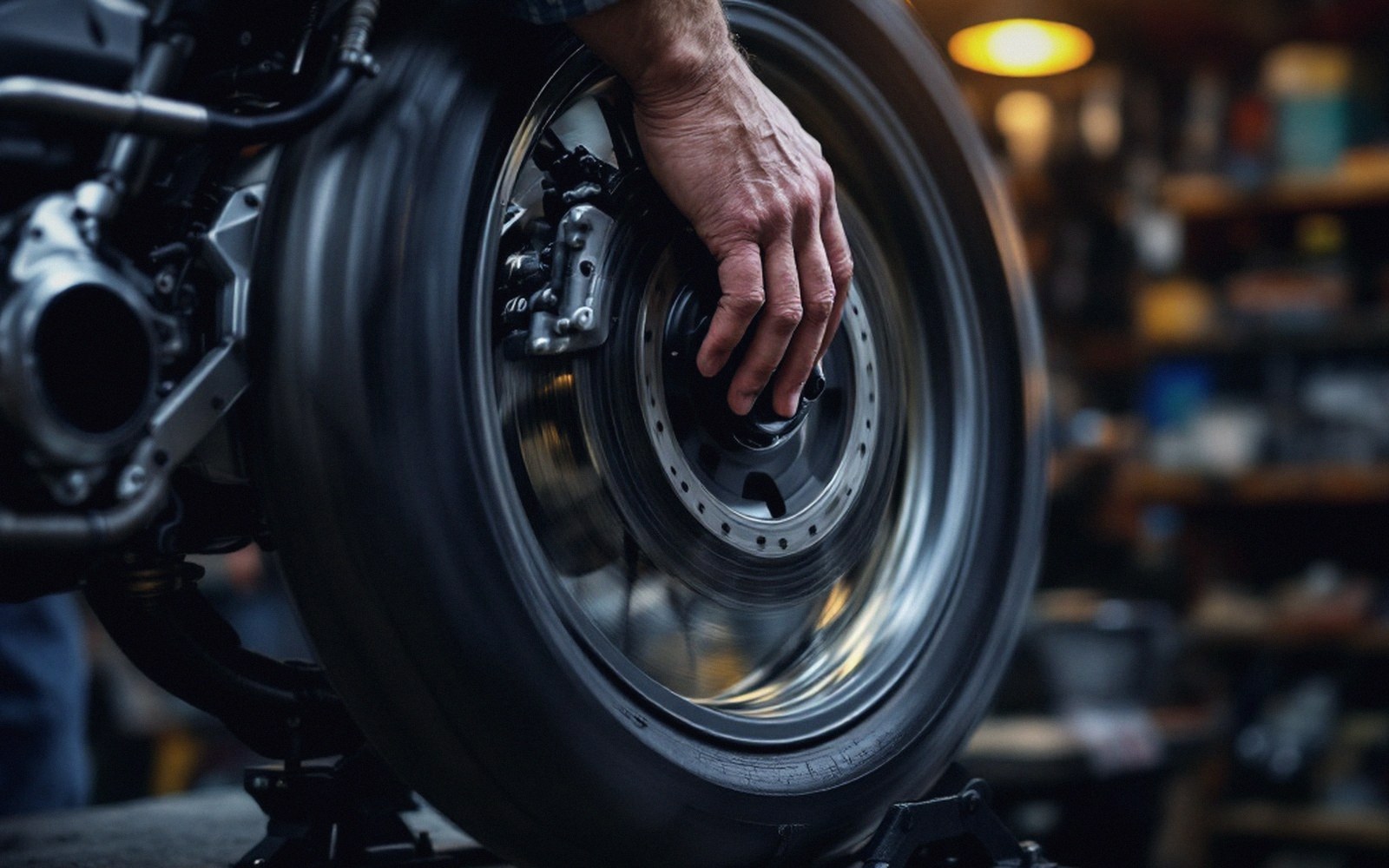
Any spinning mass resists a change to its orientation. The front wheel of a moving motorcycle is a gyroscope, and its angular momentum vector points directly along the axle — to the left when the wheel rolls forward. Try to tilt that axle — by pressing one end of the handlebar forward, for instance — and the wheel doesn't simply yield to the force. It responds, but ninety degrees away from where you pushed, in the direction the momentum vector is being dragged. That offset is precession, and it is why a bar input that looks like it should steer the wheel instead rolls the whole machine.

Press the right bar forward: you are applying a torque about the steering axis, trying to point the front wheel left. The gyroscope precesses ninety degrees from that input, and the result is a rolling moment that tips the machine to the right — into the corner. The wheel does also steer slightly left, which produces the small initial lean that countersteering exploits, but the direct mechanical consequence of the gyroscopic moment is a roll, not a yaw. The two effects arrive together, but the gyroscopic roll is the weaker contribution to the lean.
The numbers and what limits them
The magnitude of the gyroscopic moment depends on three things: the wheel's moment of inertia, its angular velocity, and the rate at which the steering axis is being turned. Moment of inertia rises with mass concentrated at the rim — heavy tyres and wide rims increase it. Angular velocity is simply road speed divided by wheel radius, so precession grows with speed and shrinks to nothing at a standstill. A rough calculation for a typical front wheel at highway speed gives a gyroscopic moment in the order of tens of newton-metres — real, but not large compared to the forces a rider's arms can apply or that the tyre generates in cornering.
This is why gyroscopic precession is often misunderstood as the dominant mechanism of steering. It is not. At low speeds it is negligible. At high speeds it assists lean initiation and contributes to directional stability, but so do trail, camber thrust, and the rider's own mass redistribution. The clean experiment is to spin a wheel by hand and try to precess it: the resistance is obvious and the ninety-degree response is unmistakable. On a moving motorcycle those same physics are present, layered under everything else happening simultaneously.
Stability and the rear wheel
The rear wheel is also a gyroscope. Because it cannot steer, its precession moment acts differently: it resists lean rather than redirecting it, adding a stabilising contribution to straight-line running. At very high speeds — on a long straight, at racing pace — this rear-wheel gyroscopic stiffness becomes measurable. BMW Motorrad engineers and others have documented how counter-rotating crankshafts (used on some flat-twin and inline-four configurations to cancel engine gyroscopic moments) alter straight-line feel, precisely because they are subtracting a gyroscopic term, not adding a mechanical device.

The engine itself is a collection of gyroscopes. Crankshafts, flywheels, clutch assemblies — all spin, all have angular momentum vectors, all precess when the motorcycle leans or yaws. On an inline-four layout the crank runs transversely, so its angular momentum vector is parallel to the wheel axles; leaning the machine precesses it forward or backward, adding a yawing moment that tends to push the machine into or out of the corner depending on which way the crank turns. Engine designers at Honda and Ducati treat this as a known quantity in layout decisions, not an afterthought.
The physics of precession are nineteenth-century mechanics. Their application to a machine that leans, steers, and has multiple spinning masses at different orientations is where it becomes genuinely complex — and where the difference between understanding the mechanism and predicting its behaviour in combination with everything else the chassis is doing becomes apparent.
Read next
Elsewhere on the site Geometry
Rake and trail
The head angle and the distance the contact patch trails behind the steering axis decide how willingly the machine turns and how hard it resists.
 The Front End
The telescopic fork
Almost universal and structurally poor: it bends under braking and its damping fights its own suspension duty.
 Engine as Layout
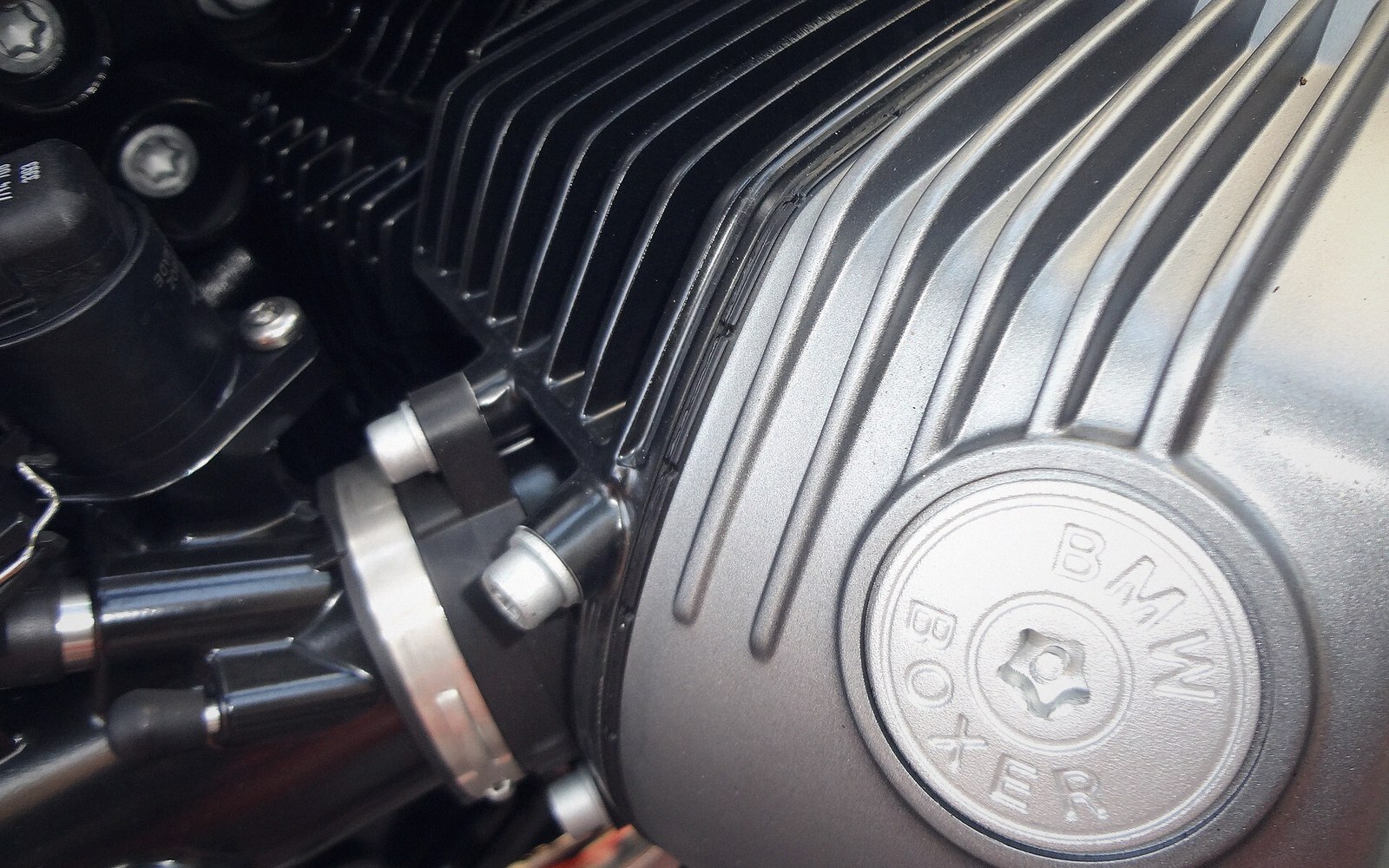
The flat twin
Cylinders in the airflow and mass carried low, at the cost of width and a torque reaction when you blip it.