The Telescopic Fork
Almost universal and structurally poor: it bends under braking, and its damping oil has to perform two incompatible jobs at once.

Why Something So Flawed Won
The telescopic fork appeared in production in the 1930s and has dominated front suspension ever since — not because engineers couldn't think of anything better, but because it packages beautifully. Two tubes sliding inside two larger tubes, spring and damper buried inside the same leg, the whole assembly bolted directly to the steering head: the geometry is compact, the part count is low, and the manufacturing tolerances are achievable by ordinary industry. BMW Motorrad was among the early adopters, and the form has changed so little in outline that a photograph from 1950 is still recognisable today.
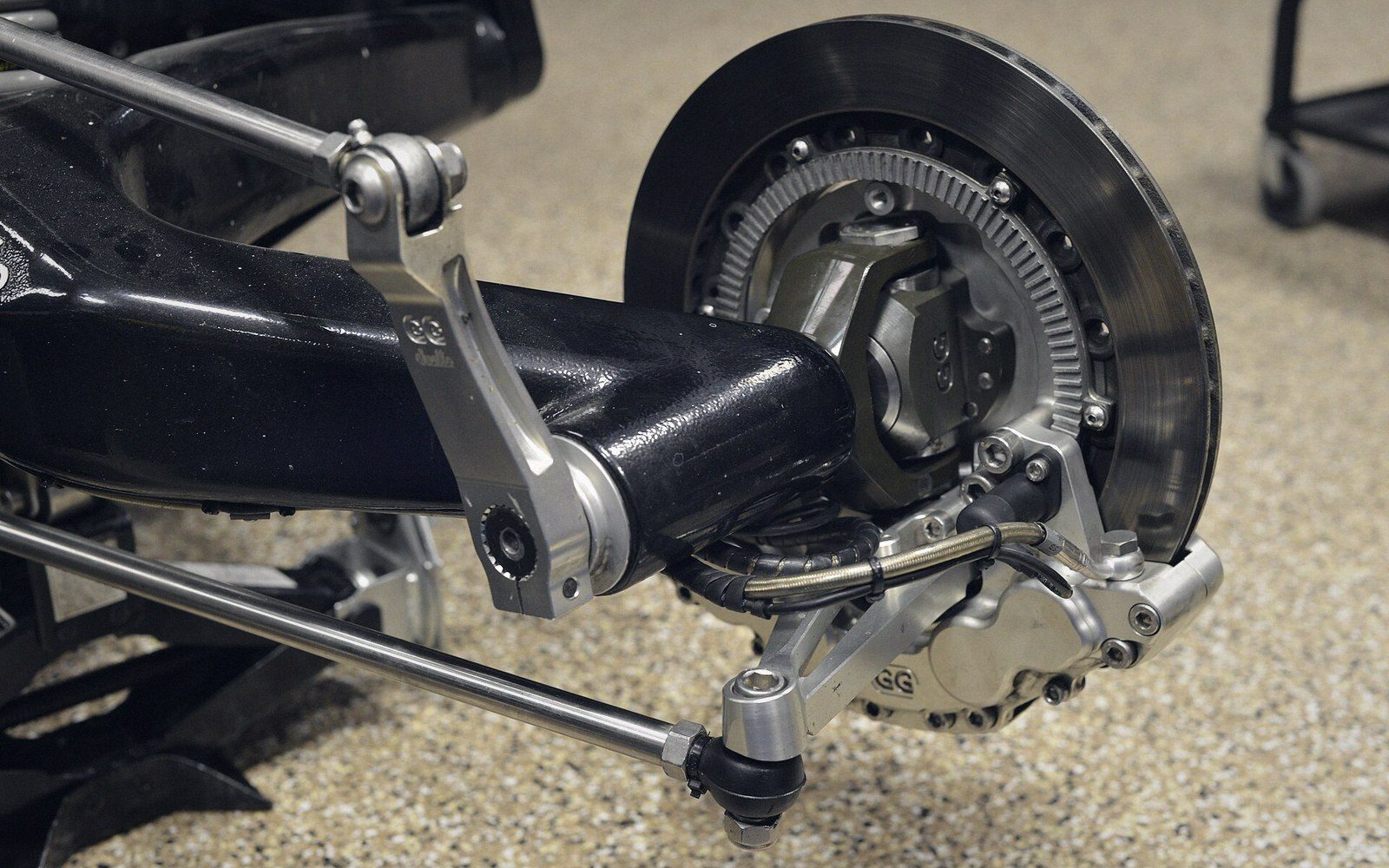
The structural problem is inherent, not accidental. A telescopic fork is a cantilever loaded in bending. The axle sits at the free end; the steering head is the fixed point. Every braking force, every bump reaction, every cornering load is transmitted as a bending moment up that pair of sliding tubes — and a sliding joint is about the worst possible thing to put in a bending load path, because the inner tube must be free to move axially while simultaneously resisting lateral deflection. The resulting stiction, the friction that must be overcome before the suspension can move, rises with braking force: exactly when suspension compliance matters most, the fork is fighting itself.
The Damping Contradiction
Damping inside a telescopic leg works by pushing oil through calibrated orifices as the tube strokes. That oil has one job: resist velocity. But the fork's bending load pushes the inner tube sideways against the outer, raising the sliding friction independently of any orifice tuning. The result is that the perceived damping is partly real damping from the oil, and partly stiction from side loading — and the two are impossible to separate without a test rig. Instrumented testing with displacement sensors can distinguish them; rider feel almost never can.

Attempts to separate the functions have occupied engineers for decades. Upside-down (inverted) forks, with the larger-diameter tube at the top clamped to the yokes and the smaller sliding down to the axle, put stiffer material where the bending stress is highest. The geometry of the problem doesn't change, but the stiffness at the critical cross-section does. Racing machines from Honda and Ducati, and most open-class motorcycles, adopted inverted forks through the 1980s and 1990s. The stiction is lower; the fundamental conflict between sliding and bending remains.
Cartridge damping, developed through the 1980s, was a more useful refinement. Rather than relying on the oil level inside the entire leg, a self-contained hydraulic cartridge sits inside the fork tube, its valving independent of the oil that bathes the spring. Compression and rebound circuits can be tuned separately, and adjusters — typically accessible at the top cap — allow meaningful changes without disassembly. The cartridge doesn't fix the bending problem, but it means the damping you set is closer to the damping you get.
What the Numbers Actually Measure
Fork geometry is measured at rest. Rake — the angle of the steering axis from vertical — and trail — the horizontal distance between where that axis meets the ground and where the tyre actually contacts it — are typically quoted as static values. Under hard braking, the fork compresses and both figures change: rake decreases, trail shortens, and the self-centering behaviour of the steering shifts. A fork with 100 mm of travel can swing the trail figure by a meaningful amount through its stroke, which is why static geometry specs tell only part of the story. The interaction between dive and steering feel is examined in detail in the guide on dive.

Axle clamp design matters more than it is usually discussed. A pinch bolt that grips the fork leg asymmetrically introduces a small bending pre-load at rest. Racing teams machine axle clamps to precise tolerances and torque sequences specifically to avoid this, because any initial misalignment adds to the braking-induced deflection rather than starting from zero.
The telescopic fork's longevity is a testament to how much careful engineering can extract from a structurally awkward idea. Hub-centre and leading-link designs separate braking loads from suspension motion more cleanly, and none of them has displaced the sliding tube in volume production. Packaging wins.
Read next
Elsewhere on the site Steering
Countersteering
Above walking pace you turn by pushing the bar away from the corner and the machine falls into the turn.
 Geometry
Rake and trail
The head angle and the distance the contact patch trails behind the steering axis decide how willingly the machine turns and how hard it resists.
 Engine as Layout
The flat twin
Cylinders in the airflow and mass carried low, at the cost of width and a torque reaction when you blip it.