Alternatives that Lost
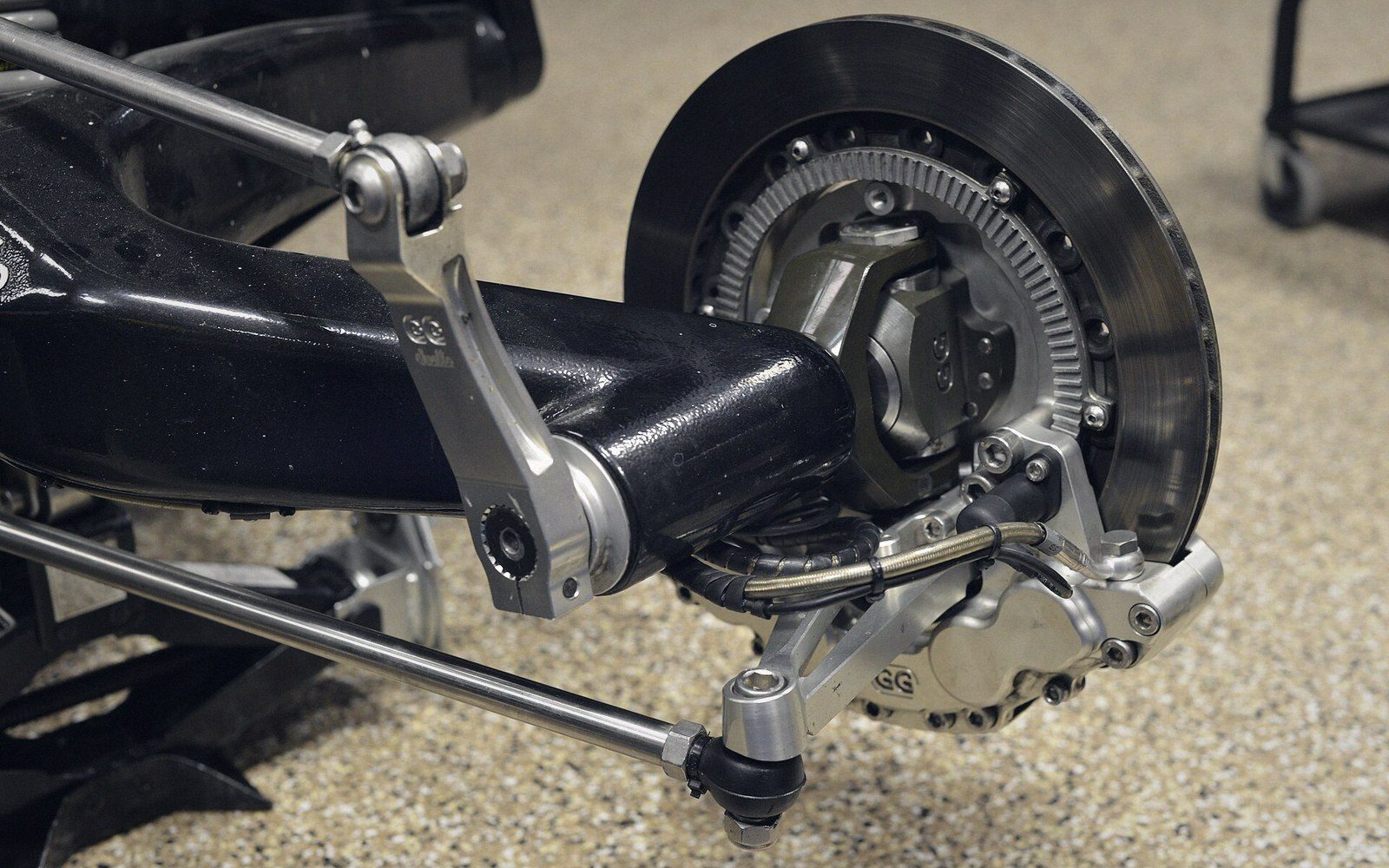
Hub-centre and leading-link designs solve the dive problem cleanly — and keep disappearing from production.
Why the Telescopic Fork Keeps Winning
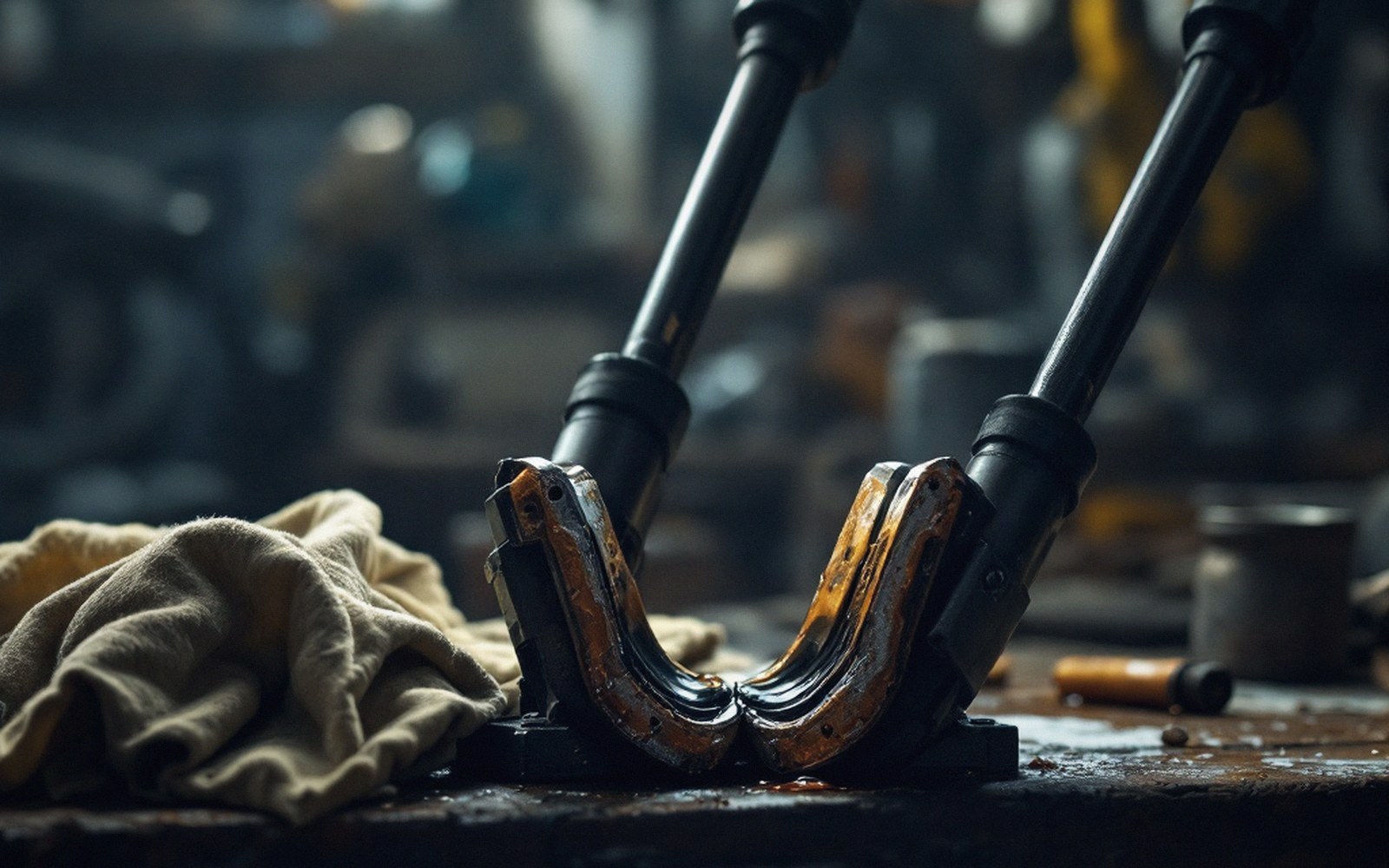
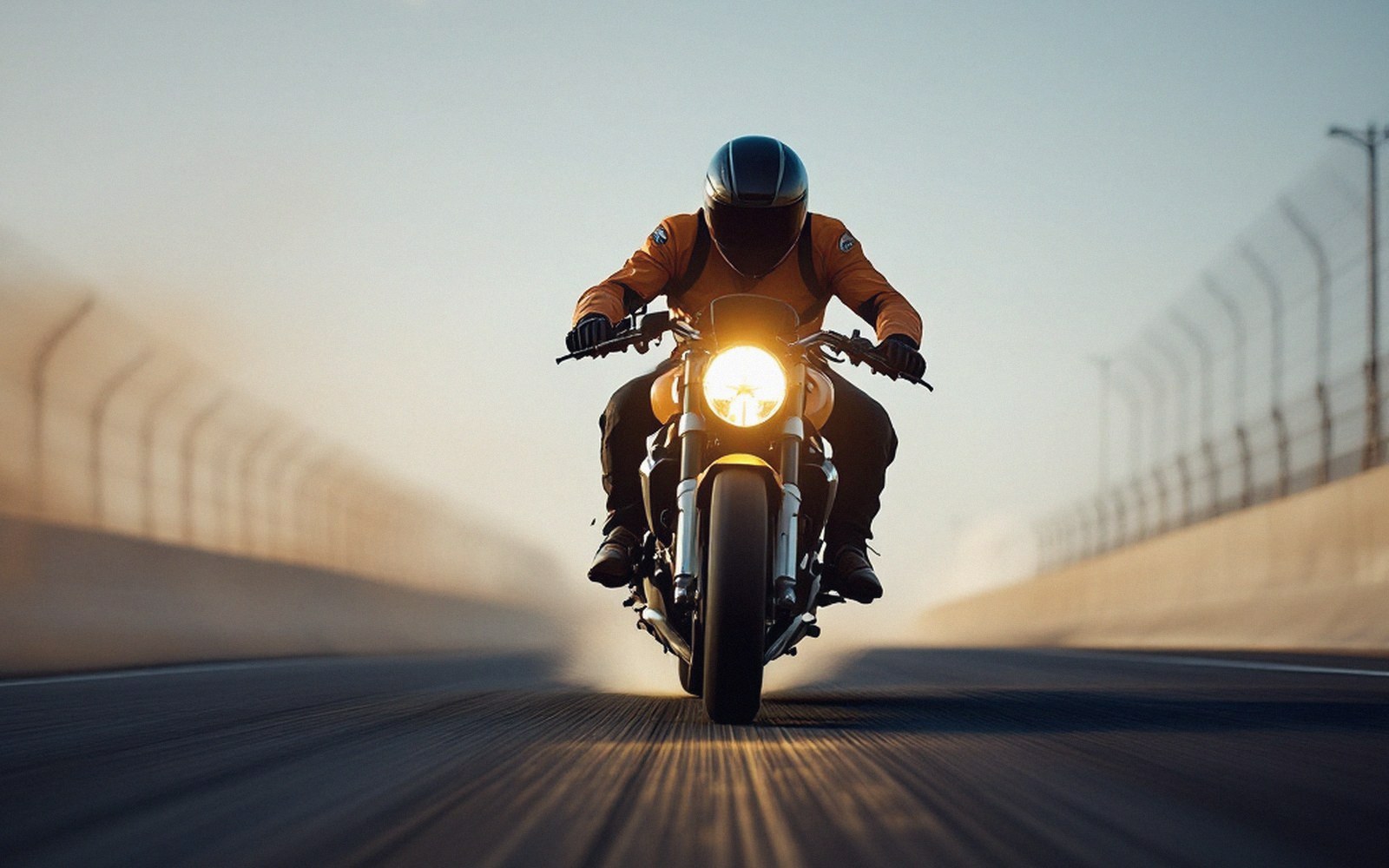
The telescopic fork bundles four functions — springing, damping, steering, and carrying brake reaction — into one compact, cheap, easily manufactured assembly. The bundle is also its structural weakness: braking loads travel straight into the fork legs, compressing the suspension and changing every geometry figure while you are using it. That compromise has been understood since at least the 1950s, and engineers have been proposing cleaner solutions for just as long. None has stuck.
The core idea behind every alternative is separation of duties. If you decouple the steering from the springing, and give brake reaction its own load path, the wheel can move vertically without the nose diving, without the trail growing, and without the steering going heavy. On paper this is strictly better. In practice, the telescopic fork's cost and simplicity have defeated every challenger.
Leading Links: The Geometry That Works
The leading-link fork places the wheel on a short arm that pivots forward of the axle. The spring and damper are separate and carry no steering loads. Brake reaction runs through the link geometry rather than through the suspension, so braking produces little or no dive. BMW Motorrad used a leading-link front end — the Earles fork, designed by Ernest Earles — on their flat-twin production machines from 1955 into the late 1960s, and it gave those machines notably stable braking behaviour. Racing sidecar outfits still favour leading-link designs, because the geometry suits three-wheeled dynamics and longevity matters more than parts-bin economics.
The disadvantage is mass. Moving a longer, more complex linkage instead of a plain slider increases unsprung weight, which is the mass that the spring cannot isolate. High unsprung weight means the wheel tracks rough surfaces less faithfully, and that matters at the front where steering feel originates. The Earles fork was also wide, which compromised lean angle — acceptable in the era of 500cc pushrod engines, less so as power grew. When Honda and others demonstrated in the early 1970s that a well-made telescopic fork could handle disc-brake loads without obvious handling penalties, the leading link quietly retired from road production.
Smaller-pivot leading-link designs, with a very short arm and the pivot close to the axle, reduce the unsprung-mass penalty while retaining most of the anti-dive geometry. Several manufacturers have offered them in series production — most consistently on lightweight machines where unsprung mass is already low — but none has displaced the fork in the mainstream.
Hub-Centre Steering: The Ambitious Attempt
Hub-centre steering goes further. The wheel is carried on a stub axle within the hub, and steering forces are transmitted by a separate linkage that passes through or around the wheel centre. Spring, damper, and steering mechanism are fully decoupled. Dive under braking is essentially eliminated; brake torque does not reach the steering at all.
Massimo Tamburini's Bimota Tesi, first shown in the early 1980s and produced in small numbers from 1990 through the decade and again later, is the most-documented hub-centre road machine. Its layout is geometrically elegant and the absence of fork dive is immediately measurable. The telescopic fork's structural compromises are genuinely absent. What the Tesi introduced instead was complexity: many more bearings, pivots and links, all of which require more precise manufacture, more regular maintenance, and greater difficulty in adjustment. The feedback path from tyre to bar is longer and filtered through more joints, and some riders found the steering less communicative for that reason.
Yamaha's GTS1000, produced through the 1990s, brought a related hub-centre concept — the Omega frame designed by James Parker — to a volume production motorcycle at something approaching a reasonable price. It sold modestly and was discontinued. The engineering was sound; the market was not persuaded that the gains outweighed the unfamiliarity and the parts costs.
The deeper problem these systems share is that fork dive, whatever its theoretical costs, is something riders are accustomed to reading as a braking cue. A system that eliminates it removes a signal the rider has already learned to use, and that requires an adjustment whose value is hard to communicate on a showroom floor. The telescopic fork's bundle of compromises, it turns out, also bundles a set of behaviours that work together in ways that are only obvious once something separates them.
Read next
Elsewhere on the site Steering
Countersteering
Above walking pace you turn by pushing the bar away from the corner and the machine falls into the turn.
 Geometry
Rake and trail
The head angle and the distance the contact patch trails behind the steering axis decide how willingly the machine turns and how hard it resists.
 Engine as Layout
The flat twin
Cylinders in the airflow and mass carried low, at the cost of width and a torque reaction when you blip it.