The Featherbed
Norton's 1950 frame showed what stiffness was worth — and the previous generation of frames had no answer
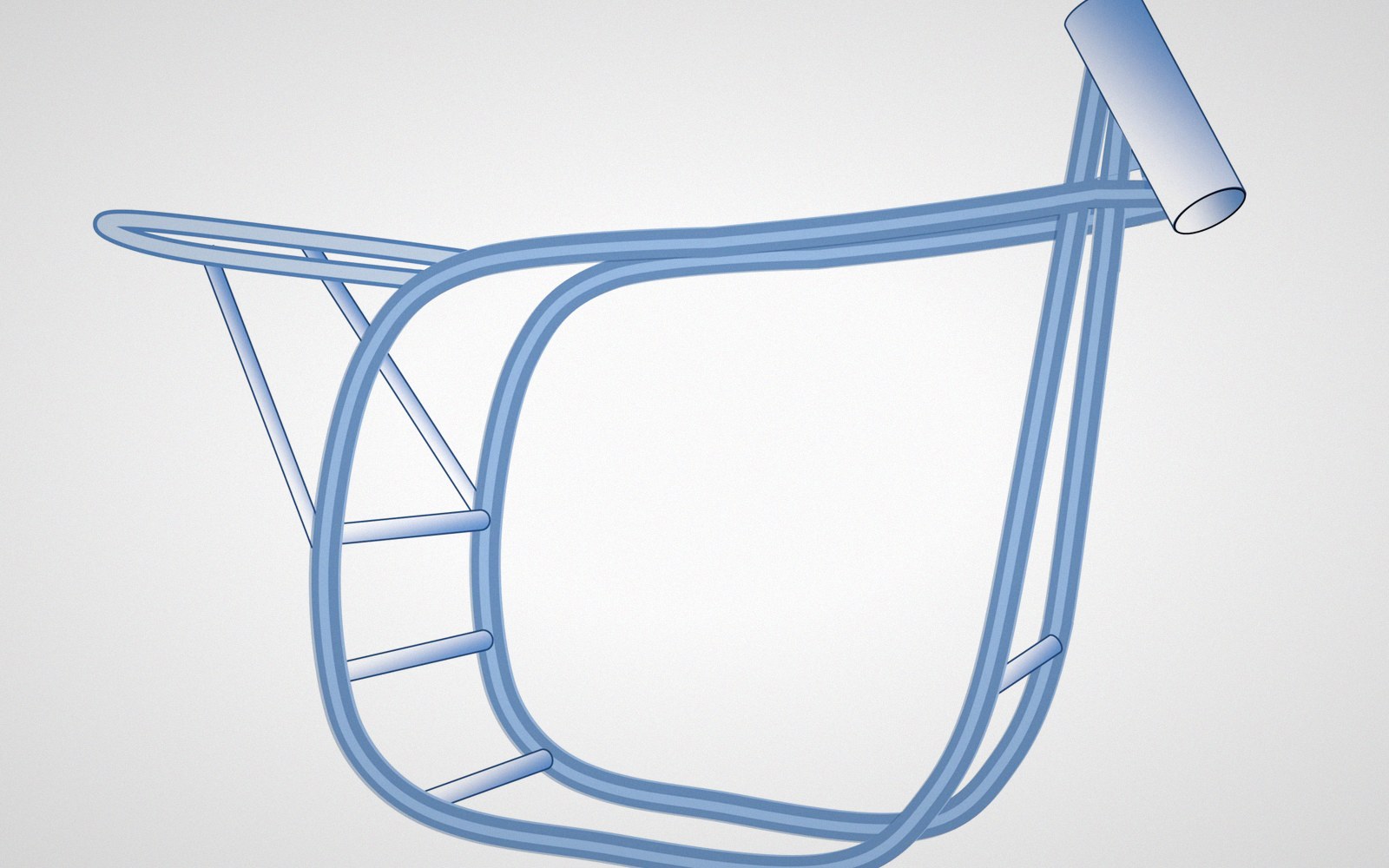
Rex and Cromie McCandless were Belfast engineers, not Norton men. The frame they built for Norton in 1950 was a freelance solution to a problem the Birmingham factory had been papering over with rider skill: the Manx Norton's engine was fast enough to expose every weakness in a brazed loop frame that flexed, wove and let the front end wander at exactly the moment the rider needed it to be decisive.
The frame they delivered had a name almost immediately. Works riders testing the prototype at Montlhéry reportedly called it "featherbed" — a description of feel, not structure. The name stuck precisely because it captured something real. The frame was not soft; it was controlled. Rigidity removed the unwanted movement, and what remained was suspension doing its job cleanly.
What the brothers actually built
The Featherbed is a full duplex loop, meaning twin tubes run continuously from the steering head, curve down through the seat area and return to the swingarm pivot. A second pair of smaller tubes triangulates the upper section. The whole assembly is welded, not brazed — an important distinction because welding produces a continuous bead rather than a joint packed with brass filler, and the resulting structure is stiffer for a given tube diameter and wall thickness. A welded trellis and spine geometry can be lighter for equivalent rigidity, or stiffer for equivalent weight. The McCandlesses used both: the Featherbed was measurably stiffer than the Manx's garden-gate predecessor and lighter too.
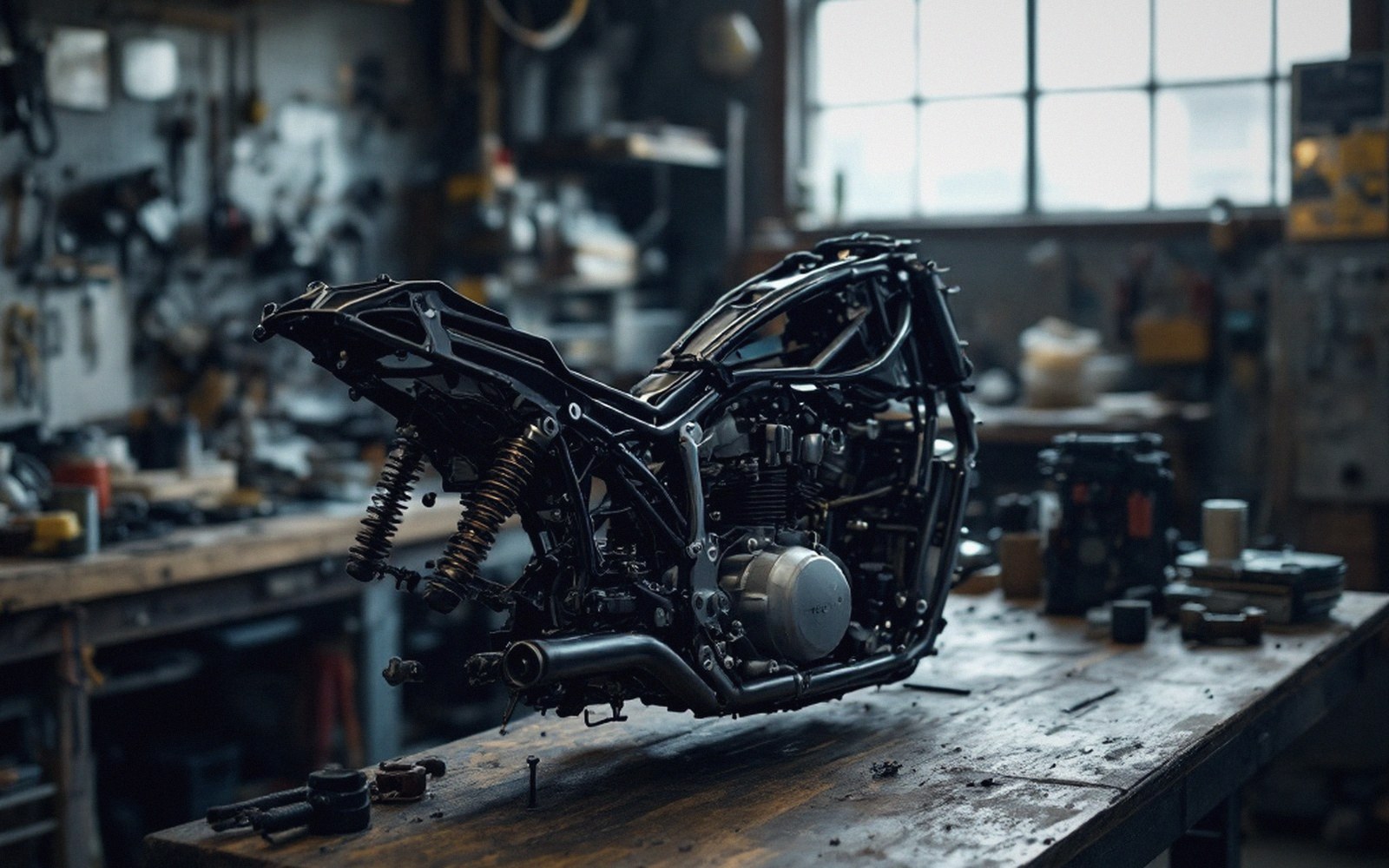
The frame is also wider than it looks. The twin top rails are spaced far enough apart that the rider sits in the frame rather than on top of it. This lowered the centre of mass slightly and placed the rider's mass between the rails, which helped keep the polar moment of inertia — the resistance to pitching and rolling — in a useful range. The geometry of steering head angle and fork offset was already understood in broad terms by 1950; what the Featherbed did was hold that geometry under load. A frame that flexes under cornering force is one where the actual rake and trail the tyre sees differ from what was measured at rest. The McCandless frame kept the numbers real.
The swingarm rear suspension deserves equal attention. The loop frame's original purpose — carrying a rigid rear axle — had limited what was possible at the back. The Featherbed's paired-tube swingarm, pivoting on the main frame, gave more controlled rear wheel travel than Norton's earlier plunger-sprung frames. It was not the first swingarm in the sport, but combining it with a stiff main structure made it far more effective than it would have been bolted to something that also flexed in torsion.
Why the difference showed up immediately
The Isle of Man TT in 1950 was the first public demonstration. Geoff Duke, riding the Featherbed-framed Norton, was visibly faster through sections where the old Manx had required correction. The lap record fell; more importantly, the margin against riders on ostensibly similar power came from chassis behaviour, not engine output. This was novel. Until then, handling was treated as a function of the rider. The Featherbed made it a function of the machine.
What this revealed, somewhat uncomfortably for the rest of the industry, was that existing frames were not good enough to use the power they were already carrying. The problem was not under-powered engines. It was frames that introduced degrees of freedom the steering geometry then had to fight. When a frame yields in torsion under cornering load, the front wheel steers slightly in a direction the rider has not requested. The response is either a correction from the rider or, at speed, a developing weave. Experienced riders had learned to manage this. The Featherbed removed the need.
Norton's dominance in the early 1950s Grand Prix seasons, with Duke taking multiple world titles, is partly an engine story — the Manx motor was competitive — but substantially a chassis story. Bologna and Munich were watching. Ducati and BMW Motorrad both developed more rigorous chassis thinking across the following decade, and the benchmark they were working from was a frame from Belfast.
What the Featherbed did not solve, and what came next
Stiffness is not the only chassis variable. The Featherbed was a considerable dry mass — later versions weighed around 16 to 18 kg for the frame alone — and while that was competitive in 1950, it became a ceiling as the decade progressed and power-to-weight ratios at the front of the grid tightened. The frame was also narrow enough that fitting larger-displacement or multi-cylinder engines was constrained; the so-called slimline Featherbed, introduced in 1960, moved the top rails inward to clear the wider Honda-derived thinking about inline-four layouts, though by then Norton's factory racing programme was winding down.
The deeper legacy is in what the Featherbed proved about torsional rigidity as a design target. Before it, frame design was largely iterative and intuitive — you built what you had built before, heavier if something broke, lighter if it held. The McCandless frame gave engineers a working example of what a deliberately stiff structure produced in measurable lap-time terms. The argument for rigidity no longer needed to be theoretical.
Honda, when it entered Grand Prix racing in 1959, brought a chassis philosophy in which engine, frame and suspension were developed together as a system. That methodology owed something to the empirical lesson from the Isle of Man — that the frame is not a neutral carrier but an active variable in how the machine steers. The telescopic fork, which remained universal partly because it was manufacturable and partly because the Featherbed had made everything else look adequate, retained its structural compromises; those would take another generation to argue seriously. What the Featherbed established was the question worth asking: not how light or how cheap, but how stiff, and where.
Read next
Elsewhere on the site Steering
Countersteering
Above walking pace you turn by pushing the bar away from the corner and the machine falls into the turn.
 Geometry
Rake and trail
The head angle and the distance the contact patch trails behind the steering axis decide how willingly the machine turns and how hard it resists.
 The Front End
The telescopic fork
Almost universal and structurally poor: it bends under braking and its damping fights its own suspension duty.